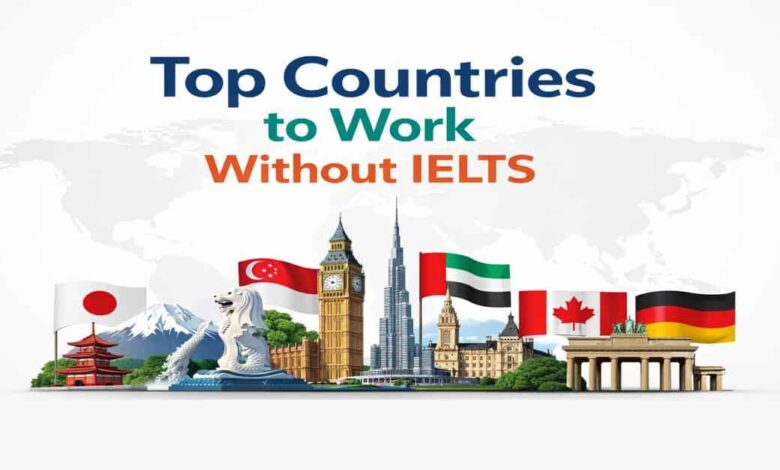
For many skilled professionals, the biggest hurdle in moving abroad isn’t the visa itself it’s the assumption that IELTS is mandatory. In 2026, several countries now allow foreign workers to secure jobs without taking this exam, especially through employer-sponsored, skills-shortage, or English-education-based pathways.
This shift means you can fast-track your international career using work experience, a Medium of Instruction letter, or alternative proof of English proficiency instead of spending months preparing for a test.
Here are the top countries you can work without IELTS right now, plus the exact pathways that make it possible.
1) Germany
For professionals who wish to work overseas without taking the IELTS, Germany is still one of the best possibilities.
For most EU Blue Card, skilled worker, and employer-sponsored roles, IELTS is usually not part of the visa requirement. What matters more is:
- an acknowledged degree
- A job offer
- threshold for salary
- relevance of the skills shortage
- basic German for everyday use in certain professions
Available Jobs
This is especially true for:
- IT jobs
- engineering
- healthcare
- manufacturing
- logistics
- automotive roles
Details:
Employers frequently evaluate your communication skills during interviews rather than requesting an IELTS score because many multinational corporations in Berlin, Munich, and Frankfurt use English internally.
However, there is a practical warning: language is still important even if you don’t need to take the IELTS. German certification may be significantly more significant than any English test for positions in the healthcare and governmental sectors.
2) Canada
In this regard, Canada is among the most misinterpreted travel destinations. A common misconception is that IELTS is required for many career paths. It’s untrue.
While Express Entry usually requires language tests, several LMIA-based jobs, agricultural roles, caregiving positions, truck driving jobs, and trade pathways can move forward mainly on employer sponsorship.
Available Jobs
This is common in:
- farm jobs
- food processing
- construction
- caregiving
- welding
- truck driving
- hospitality support roles
Details:
- In these situations, the employer frequently uses interviews and work experience to demonstrate your ability to perform in the workplace.
- However, IELTS or CELPIP may still be required in the future if permanent residency is your long-term objective.
- Many individuals are perplexed by that tiny distinction.
- Therefore, even though you might eventually need a language score for PR, you can work in Canada without taking the IELTS exam.
3) United Arab Emirates (UAE)
The UAE is still among the easiest places to relocate without taking the IELTS exam if you want to move quickly and make quick money.
Available Jobs
For employment in:
- hospitality
- sales
- logistics
- transport
- construction
- healthcare support
- customer service
Details:
Typically, company sponsorship rather than English exam results determines the work visa.
In the service sector, Dubai and Abu Dhabi are still hiring a lot of people, and the majority of businesses just use spoken English as a test during interviews.
This approach is effective for those who wish to:
- rapid processing
- tax-free income
- reduced obstacles to entry
- simpler first time traveling abroad
Check More: Top 5 Countries with Farm Jobs and Visa Sponsorship
4) United Kingdom
Real IELTS-free career paths are still available in the UK, particularly if your degree was taught in English or your employer can attest to workplace communication norms.
This is typical under:
- Skilled Worker Visa
- Health and Care Worker Visa
- select NHS roles
- care assistant jobs
- software engineering roles
Details:
- IELTS may occasionally be replaced with a Medium of Instruction (MOI) letter, especially if your university experience was entirely in English.
- This approach is frequently used successfully by healthcare professionals from nations like Ghana, Nigeria, India, and the Philippines.
- Checking the sponsorship policies of the particular employer is crucial since, even in cases when the visa process is flexible, employers may impose their own requirements.
5) Singapore
Singapore is a quiet but powerful option.
For Employment Pass and S Pass roles, IELTS is rarely the deciding factor. Employers care more about:
- credentials, pay, and employment history
- technical abilities
- performance during the interview
Available Jobs
This works especially well for:
- tech professionals
- finance specialists
- digital marketers
- engineers
- hospitality managers
Details:
- Formal assessment is frequently not essential if one has a solid English-speaking background from university.
- Skilled professionals frequently settle in sooner than anticipated since the nation rewards competence rapidly.
6) Japan
Japan is employing more foreign workers in:
- engineering
- IT
- caregiving
- factory work
- hospitality
- language support roles
Details:
- Usually, the work visa itself does not require the IELTS. Rather, the company prioritizes your abilities, and competence in Japanese is often more important than English.
- Many applicants are surprised by this.
- When the true prerequisite for workplace integration is frequently JLPT Japanese certification or basic spoken Japanese, people waste time worrying about IELTS.
- Therefore, if Japan is on your radar, concentrate more on job fit and language practicality than on IELTS.
What Can Replace IELTS?
- Medium of Instruction (MOI) letter
- employer interview assessment
- previous work in English-speaking companies
- degree from an English-medium university
- PTE or Duolingo (for mixed visa/education pathways)
- local language proof instead of English
These are the most popular substitutes in 2026: Because of this freedom, more people are now relocating overseas more quickly.
Relocation:
If IELTS has been the only thing stopping your relocation plans, this is your sign to stop assuming it is mandatory everywhere.
For many work visas in 2026, skills beat test scores.
- Germany rewards technical talent.
- Canada offers employer-led routes.
- The UAE moves fast.
- The UK allows exemptions.
- Singapore values experience.
- Japan prioritizes role-specific language fit.
The smarter question is no longer “Which country doesn’t need IELTS?”
It is “Which country values my current skills enough to waive it?”
That mindset gets results faster.
Conclusion:
Moving abroad in 2026 no longer hinges on clearing IELTS. Many countries now prioritize skills, experience, and practical language ability over exam scores. By focusing on your expertise and the right visa pathways, you can start your international career faster and with fewer barriers.
Frequently Asked Questions:
What can replace IELTS for visa applications?
Alternatives include a Medium of Instruction (MOI) letter, employer interview assessments, prior work in English-speaking companies, PTE or Duolingo scores, and local language proof.
Are there specific jobs that don’t require IELTS?
Yes. Common roles include IT, engineering, healthcare, caregiving, construction, logistics, hospitality, and digital marketing, depending on the country.
Will I need IELTS later if I want permanent residency?
Possibly. Some countries, like Canada and the UK, may require language proof for PR, even if it’s not needed for initial work visas.