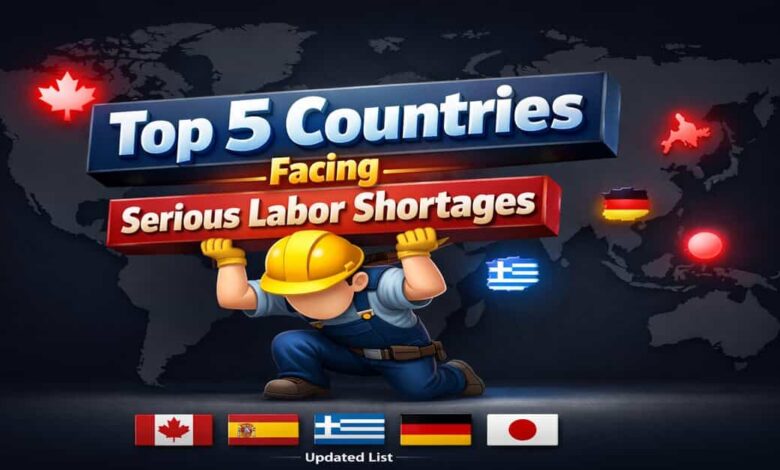
In 2026, the global workforce gap is reshaping career opportunities, with countries like Japan, Germany, Greece, Spain, and Canada facing critical labor shortages across healthcare, technology, construction, agriculture, and more.
Skilled professionals and international workers are in high demand, prompting governments to expand visa programs and streamline work permits to attract talent. Understanding these labor gaps allows job seekers to align their skills with sectors and countries offering the most opportunities, making it an ideal time to explore international careers and secure positions in high-demand industries.
1. Japan: A Demographic-Driven Workforce Crisis
Japan’s workforce gap is exacerbated by its swiftly aging population and low birth rate, which consistently place it among the most labor-stressed economies in the world.
Japan has one of the highest labor shortage rates in the world, with approximately 85% of municipalities actively pursuing additional workers to maintain basic industries and services, as indicated by international labor data.
Where the Gaps Are
- Services related to senior care and healthcare
- Childcare and education
- Engineering and information technology
- Logistics and manufacturing
Japan has responded by enhancing visa categories such as the Specified Skilled Worker (SSW) and Highly Skilled Professional (HSP) visas, which facilitate the legal entry and employment of foreign professionals and technical workers. If you possess skills that are in high demand in industries such as robotics, system design, or nursing, these pathways are particularly advantageous.
For up-to-date visa and policy information, visit the official Japan immigration portal: https://www.moj.go.jp/isa/
2. Germany: The labor belt of Europe was overly tightened.
Germany, Europe’s largest economy, continues to encounter challenges in filling vacant positions in numerous sectors.
The data indicates that Germany’s qualified labor shortage rate is approximately 82%, which is indicative of the extent to which workforce gaps have become.
High-Demand Fields
- Mechanical, electrical, and automotive engineering
- Software development and information technology
- Health care professionals
- Trades and construction
In order to resolve these shortages, the German government has implemented the Opportunity Card, a points-based system that enables qualified professionals to relocate their families to Germany and pursue employment opportunities prior to securing employment.
Germany is a prime destination for foreign laborers seeking stability, benefits, and pathways to residency due to its strong industrial base and emphasis on long-term solutions.
3. Greece: Despite the implementation of new policies, there are still gaps
Greece has encountered labor shortages for an extended period, and the issue continues to be severe in 2026. Despite the recent implementation of foreign worker quotas, the disparity between the number of available positions and the availability of local labor continues.
Sectors Hungry for Workers
- Agriculture and farming
- Hospitality and tourism
- Manufacturing and construction
The Greek government’s endeavor to establish hiring limits for non-EU workers has failed to keep pace with market demands, resulting in an estimated shortage of approximately 250,000 positions. This imbalance presents job opportunities for international workers and migrants, but it also emphasizes the significance of obtaining legal employment contracts and appropriate work permits.
4. Spain: Solutions to the Rapidly Growing Labor Shortage through the Use of Foreign Talent
Another region in which the demand for laborers exceeds the supply is Spain’s labor market, particularly in the sectors of agriculture, healthcare, and tourism. Spain is experiencing shortages in approximately 78% of its critical sectors, which has resulted in a concerted effort to recruit international laborers, according to reports.
In-Demand Roles
- Caregivers and healthcare specialists
- Construction and skilled professions
- Agricultural and seasonal laborers
- personnel employed in the hospitality industry
Spain has made an effort to simplify the visa application procedure for international applicants and accepts a diverse array of short- and long-term work permits. Both skilled and semi-skilled foreigners who are prepared to relocate are attracted to programs such as the Seasonal Worker Visa and general work visas. This trend emphasizes Spain’s increasing dependence on migrant labor to support economic resilience in various sectors.
5. Canada: Recruiting Continues Despite Strong Inflows
Although Canada’s labor shortage is not as prominent as Japan’s or Germany’s, it remains one of the most significant in the developed world. According to official reports, Canada anticipates labor shortages in industries including agriculture, technology, healthcare, professions, and logistics.
Priority Hiring Areas
- Healthcare assistants and nurses
- Software and information technology architects
- Transport services and truck drivers
- Greenhouse technicians and farmworkers
Canada’s immigration system is structured to attract foreign talent through Express Entry, Provincial Nominee Programs (PNPs), and sector-specific pathways like the Temporary Foreign Worker Program (TFWP). These routes offer both temporary and permanent residence options for skilled workers ready to fill critical gaps.
For detailed information on Canada’s immigration pathways and worker programs, visit the Government of Canada immigration portal: https://www.canada.ca/en/immigration-refugees-citizenship.html
Why These Shortages Matter for Job Seekers in 2026?
Global labor markets are evolving, not contracting. The ratio of working-age individuals to retirees decreases as populations age and reproduction rates decline in numerous industrialized nations. Employers respond by:
- Expanding immigration pathways
- Loosening visa requirements for skilled foreigners
- Offering relocation incentives and wage boosts
Job seekers can better align their talents with the actual global demand by comprehending the areas where shortages are most severe. This is not mere speculation; it is supported by labor data that indicates persistent deficits and proactive government policies.
Conclusion:
In 2026, labor shortages in countries like Japan, Germany, Greece, Spain, and Canada are creating high demand for skilled and semi-skilled workers across key sectors. Governments are actively recruiting foreign talent through streamlined visas and relocation incentives. Job seekers who align their skills with these gaps can access faster hiring, better opportunities, and international career growth.
Frequently Asked Questions:
Can international workers easily get jobs in these countries?
Visa requirements vary by country and sector. Some nations offer streamlined programs for high-demand professions, while others have quotas or stricter eligibility criteria.
Are language skills necessary to succeed abroad?
Yes, in many cases. Countries like Japan, Germany, and Greece often require proficiency in the local language to improve employability and ease integration.
Do these labor shortages guarantee a job?
Not guaranteed, but high-demand sectors typically offer faster hiring, competitive salaries, and more opportunities compared to lower-demand markets.