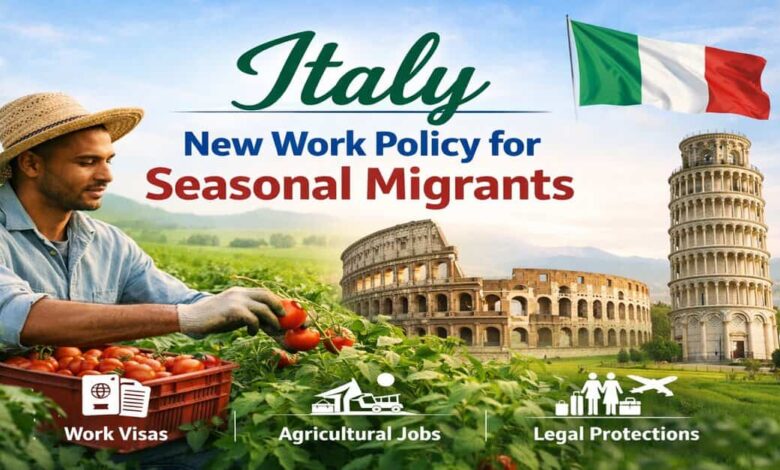
Italy New Work Policy for Seasonal Migrants marks a significant step forward for seasonal migrant workers, allowing them to work legally while their residency permits are being processed. This change aims to reduce illegal employment, protect worker rights, and help industries facing acute labor shortages, including agriculture, tourism, construction, and elder care.
With 165,000 work permits planned for 2026, the policy offers a clearer, safer path for migrants to contribute to Italy’s workforce.
New Legal Pathway for Seasonal Workers in Italy:
The Italian government has issued a regulation that authorizes seasonal migrant workers to start working lawfully prior to the conversion of their seasonal residency cards into regular work permits, which is a major development. This action occurs as Italy gets ready to provide more than 165,000 work permits in 2026, up from 151,000 in 2024 and 136,000 in 2023.
The goal of the policy change is to facilitate the smoother integration of foreign workers into the Italian labor market and lessen bureaucratic delays, particularly in industries like construction, tourism, agriculture, and elder care that heavily depend on migrant labor.
Who Can Work While Waiting for a Permit?
Seasonal migrant workers must fulfill the following requirements in order to take advantage of this new directive:
1. Proof of Application
In order to change their seasonal dwelling permit into a non-seasonal work permit, employees must show an official receipt attesting to their application.
2. Unilav Submission
A Unilav form, which is Italy’s electronic employment notification, must be submitted by the employer to mark the beginning of the employee’s employment.
3. INPS Registration
In the case of domestic work (such as caregiving), the employment relationship must be registered with Italy’s social security authority, INPS (Istituto Nazionale della Previdenza Sociale). Learn more at: https://www.inps.it
By ensuring that the employee is incorporated into the official employment system, these standards serve to safeguard their access to benefits and legal rights.
A Step Towards Ending Exploitation:
Prior to this modification, migrant workers were required to wait during the permit transition time without having any legal right to work. Many were exposed to unregulated employment, financial instability, and exploitation as a result. Both employers and migrant advocacy groups applaud the new regulation, which now provides legal protection during this waiting period.
Italy to Issue 165,000 Work Visas in 2026:
The Italian government will provide 165,000 work permits for foreign nationals in 2026 in order to address the country’s persistent labor shortages. Out of this sum:
- 93,550 visas will go to seasonal workers in key areas like agriculture and tourism.
- The remaining will support industries such as construction, elderly care, and health services.
Compared to the 89,050 seasonal work permits granted, this represents a discernible increase, indicating Italy’s increasing reliance on migrant labor.
Strong Demand for Foreign Care and Construction Workers:
The need for foreign caregivers is growing as Italy’s population ages. Ten thousand work visas will be allocated to this industry in 2026 alone. Due to ongoing staff shortages and infrastructure requirements, construction and healthcare are also high on the list of priorities.
Check More: Seasonal Work Visas in Italy
Italy’s Long-Term Migration Strategy:
This modification is a component of the Italian government’s larger three-year migration plan, which establishes yearly visa quotas to address demographic and economic demands. The strategy seeks to:
- Simplify the process of employing international employees
- Minimize erratic work
- Encourage long-term immigration policy
Italy is developing a more organized and inclusive labor system by establishing legal avenues for employment.
What Migrants and Employers Should Know?
- As long as all conditions are met, migrants can now begin working lawfully while their permission application is being processed.
- In order to comply with the new legislation, employers must make sure that job disclosures and registrations are completed correctly.
- Prospective employees who want to work in Italy in 2026 should think about prospects in caregiving and seasonal industries, which are among the most in-demand.
Conclusion:
This policy shift not only safeguards migrant workers from exploitation but also streamlines Italy’s labor market, ensuring critical industries have the staff they need. By providing legal work opportunities during the permit process, Italy is creating a more efficient, fair, and sustainable system for both employers and employees. The reform underscores the country’s commitment to a structured, inclusive approach to migration and workforce planning.
Frequently Asked Questions:
Who is eligible to work under this regulation?
Seasonal migrant workers who have submitted a valid application to convert their seasonal permit, with proper employer registration via the Unilav form and, for domestic work, INPS registration, are eligible to work legally while waiting for their permit.
How many work permits will Italy issue in 2026?
Italy plans to issue a total of 165,000 work permits in 2026, including 93,550 for seasonal workers in agriculture, tourism, and other key sectors.
Which industries benefit most from this policy?
Agriculture, tourism, construction, elder care, and healthcare are the main sectors that benefit, addressing labor shortages and ensuring legal employment for migrant workers